Live Assembly Environment · Productivity Engine · Multi-File Build Control
Enjektor
Code Assembly Engine
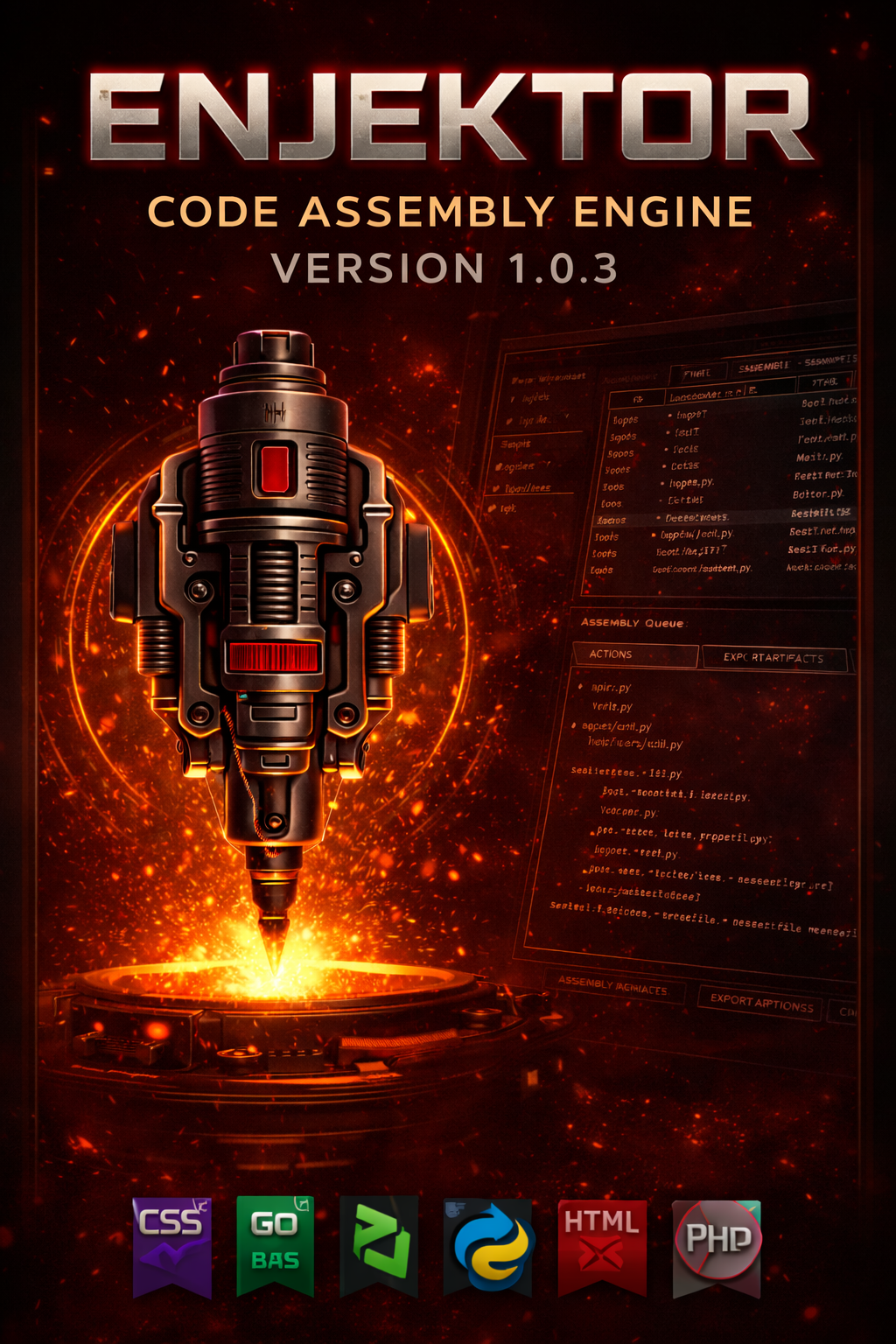
Enjektor - Code Assembly Engine - Version 1.0.3 is a modular software construction platform built for developers who want speed, repeatability, reusable code, and less time wasted gluing projects together by hand. Instead of rebuilding the same scaffolding over and over, Enjektor stores reusable code fragments, assembles them into multi-file projects, preserves repeatable build profiles, and exports working structures with dramatically lower friction.
This is not a passive landing page. It behaves like a live shell around the product itself. Interfaces breathe. panels flicker. scanners sweep. snippets appear. output streams type themselves into existence. The whole page is designed to feel like the machine is already awake.
Reusable Snippet Library
Store headers, Python, PHP, Go, Bash, HTML, CSS and text fragments for repeatable assembly.
Multi-File Project Generation
Build nested paths like app.py, utils/helpers.py, static/css/style.css and complete project trees.
Export and Build Velocity
Profiles, dependency awareness, zip creation, virtual environment generation, and executable build flow save real time.
Snippet Library Online
Multi-File Preview Active
Export Queue Armed
Profiles Saved · Builds Repeatable
Living Console
Enjektor is built around the idea that software construction should feel immediate. The demonstration stream below simulates snippet loading, profile recall, assembly, dependency detection, and export activity, reflecting the exact kind of productivity gain this application is meant to unlock.
Enjektor Runtime Console · Self-Animating Build Feed
Feature Arsenal
Enjektor is a developer productivity platform centered on modular code reuse, project structure generation, faster exports, cleaner repetition, and lower friction between idea and artifact. It is ideal for prototyping, internal tool generation, repeated scaffolding, utility authoring, payload construction, helper script composition, and software kits that share common internal patterns.
Snippet-Driven Project Assembly
Store discrete pieces of working logic as reusable units and recompose them into larger artifacts whenever needed. This reduces repetitive boilerplate work and encourages structured reuse instead of chaotic copy and paste.
Language-Spanning Construction
Assemble projects that mix Python, PHP, Bash, Go, HTML, CSS, and text assets, allowing Enjektor to act as a software staging platform rather than a single-language toy.
Multi-File Preview and Export
Work with nested output paths, inspect assembled content file by file, export full project trees, and package them as archives without flattening everything into one useless slab.
Profile-Based Repeatability
Save working queue orders and build settings as profiles so reliable combinations can be recalled instantly, improving consistency across recurring tasks and reducing setup fatigue.
Dependency-Aware Workflow
Infer and preserve relevant dependency information during export, making project generation faster, cleaner, and more deployment-friendly when compared with assembling projects manually every single time.
Build-Ready Productivity
Create a virtual environment, install requirements, package output, and prepare executable builds through one controlled interface that keeps the workflow aligned with the assembly process.
Modular Workflow Blocks
The system is intentionally modular. Each section below can collapse or expand as needed, letting the page mirror the application itself. Open the blocks that matter, skim the rest, and treat the layout like a software chassis with removable panels.
Enjektor begins with a reusable snippet library. Headers, helper functions, shell blocks, interface fragments, content pieces, and code scaffolds can all be stored as distinct units. The benefit is immediate: once a fragment proves useful, it stops being disposable. It becomes a durable component that can be injected into future builds. This makes Enjektor valuable for teams and solo builders alike because stable logic becomes inventory rather than recurring labor.
Ordering matters. Enjektor lets snippets be placed into a queue and re-ordered before assembly, which means the final artifact is controlled rather than improvised. Headers can be placed first, logic blocks can follow in a deliberate sequence, and supporting content can be slotted exactly where it belongs. This supports reliable project generation and reduces the friction of rearranging code fragments by hand.
Enjektor does not have to collapse everything into a single file. Snippets can target paths like
app.py, utils/helpers.py, static/css/style.css, or templates/index.html. That makes the engine useful for real project structures, not just demos. The productivity gain here is enormous because a reusable architecture can be reconstructed from stored parts in seconds.
Once a queue and build configuration prove useful, they can be saved as a profile. That means repeated patterns can be recalled instantly instead of being reconstructed every time. Exports can generate project folders, dependency manifests, and zip archives, while build actions can continue into virtual environment creation or executable packaging. Enjektor turns repeated software setup into a reusable path instead of a recurring drain.
Why Enjektor Increases Productivity
Software work is full of repeated foundations: imports, utility wrappers, menu shells, config loaders, content blocks, deployment helpers, template files, logging sections, preview stubs, packaging commands. Enjektor captures those recurring structures and transforms them into callable build inventory.
When proven code fragments are preserved and indexed, the next project starts closer to done. Time is spent refining and adapting instead of manually reconstructing old work.
Profiles and snippet reuse create a steadier architecture across multiple tools. Naming, structure, helper logic, and repeated behaviors stop drifting apart.
Enjektor is ideal for proof-of-concept tools, utilities, internal dashboards, shell wrappers, HTML landing pages, script packs, test harnesses, and deployment helpers because it shortens the distance between intention and artifact.
The application reduces context switching. The same environment that stores fragments also previews them, assembles them, exports them, packages them, and records repeatable build states.
Search, Discovery, and Technical Positioning
Enjektor belongs in searches involving modular code builders, developer productivity applications, snippet-based project generation, internal utility creation, multi-file export tooling, reusable code systems, GUI build helpers, and rapid software prototyping workflows.
What This Software Is
Enjektor is a code assembly engine for storing, ordering, previewing, exporting, and packaging reusable software fragments into complete outputs. It is especially effective for builders who routinely create utilities, scripts, landing pages, helper modules, wrappers, and repeated framework scaffolds. Its value comes from preserving working logic and turning it into inventory that can be reassembled quickly.
code assembly engine
modular code builder
snippet library
project generator
developer productivity
software prototyping
What This Software Does
It lets users organize snippets by type, queue them in an intended order, preview assembled results, generate multiple files, export project trees, produce archives, save build profiles, infer dependencies, and move from concept to reusable output with less delay. That makes Enjektor useful for software engineers, toolsmiths, security workflow builders, automation authors, and anyone who repeatedly composes similar structures.
multi-file export
Python build GUI
reusable code workflow
zip project generator
profile driven build tool
Tkinter application
Operational Questions
Short answers for developers, builders, and curious scanners who want the essence without the ceremony.
Enjektor is for developers, internal tool builders, automation authors, security workflow designers, and anyone who repeatedly assembles similar software structures. It is especially useful when proven code fragments deserve to become reusable inventory.
A paste bin stores fragments. Enjektor assembles them. Queue ordering, profile recall, file-path targeting, preview, export, dependency handling, and build actions turn stored code into reconstructable software rather than a dead pile of snippets.
Yes. The speed gain comes from not rebuilding foundations repeatedly. As more stable snippets and profiles are stored, the next project begins with more of the answer already in hand.
Yes. Enjektor supports nested output paths and grouped file assembly, which means it can export practical project structures rather than collapsing everything into a single file.
Accessories // System Extensions
These components extend Enjektor beyond passive assembly. They are not optional fluff — they are operational layers that control execution, manipulation, and structural authority over the build process.
launcher.py · Runtime Ignition Layer
This is the controlled entrypoint into Enjektor’s execution cycle. It does not simply “start the app” — it establishes runtime state, loads configuration, initializes environment expectations, and prepares the assembly engine for deterministic operation.
The launcher enforces consistency between sessions, ensuring that builds begin from a known state instead of inheriting drift, residue, or undefined conditions. It is responsible for activating the system in a way that keeps outputs predictable and repeatable.
Without this layer, the engine has no reliable ignition. With it, every session begins aligned, structured, and ready for controlled assembly.
editor.py · Assembly Control Interface
The editor is where Enjektor stops being a storage system and becomes a precision tool. It provides direct control over snippet composition, queue structure, and pre-assembly manipulation without requiring modification of the core engine.
Snippets can be modified in-place, reordered with intent, reshaped before injection, and aligned with target file structures. This allows builds to be corrected, refined, or entirely reconfigured before they ever reach export.
It is not just an editor — it is the command surface for shaping output. Every assembled artifact passes through this layer, making it the most critical point of control in the entire system.
Runtime Model · Zero Dependency Execution
Enjektor Version 1.0.3 and all included utilities are built to operate on a standard Python environment without requiring external packages, frameworks, or environment setup. There are no hidden installs, no dependency chains, and no external runtime requirements.
Every component is designed to execute directly as provided. Files can be launched immediately using the default Python interpreter, making the system portable, predictable, and resistant to environment drift across machines.
This is a raw execution model. Nothing is pre-compiled, bundled, or abstracted behind packaging layers. What you see is exactly what runs — transparent, inspectable, and fully under user control from the first line to the final output.
Build faster. repeat less. keep the good parts.
Enjektor - Code Assembly Engine - Version 1.0.3 is built for software creation with memory, structure, repeatability, and force. It stores what works, assembles what matters, and keeps your next project from starting in the dark every single time.