 BOOTYBOX // SECURITY WHITE PAPER
ENCRYPTION PRIMITIVE
AES-256 is a mature symmetric cipher. A realistic attacker is not expected to brute-force the 256-bit AES key space directly.
BootyBox protects selected files and directories through a layered process: an AES-256 encrypted ZIP is created first, the entire ZIP is then encrypted again with OpenSSL AES-256-CBC using PBKDF2 and salt, and that encrypted payload is finally appended behind a valid PNG image.
The important security question is not merely, “Is AES-256 strong?” It is: what would an attacker actually attack, how expensive would that attack be, and where are the practical weak points?
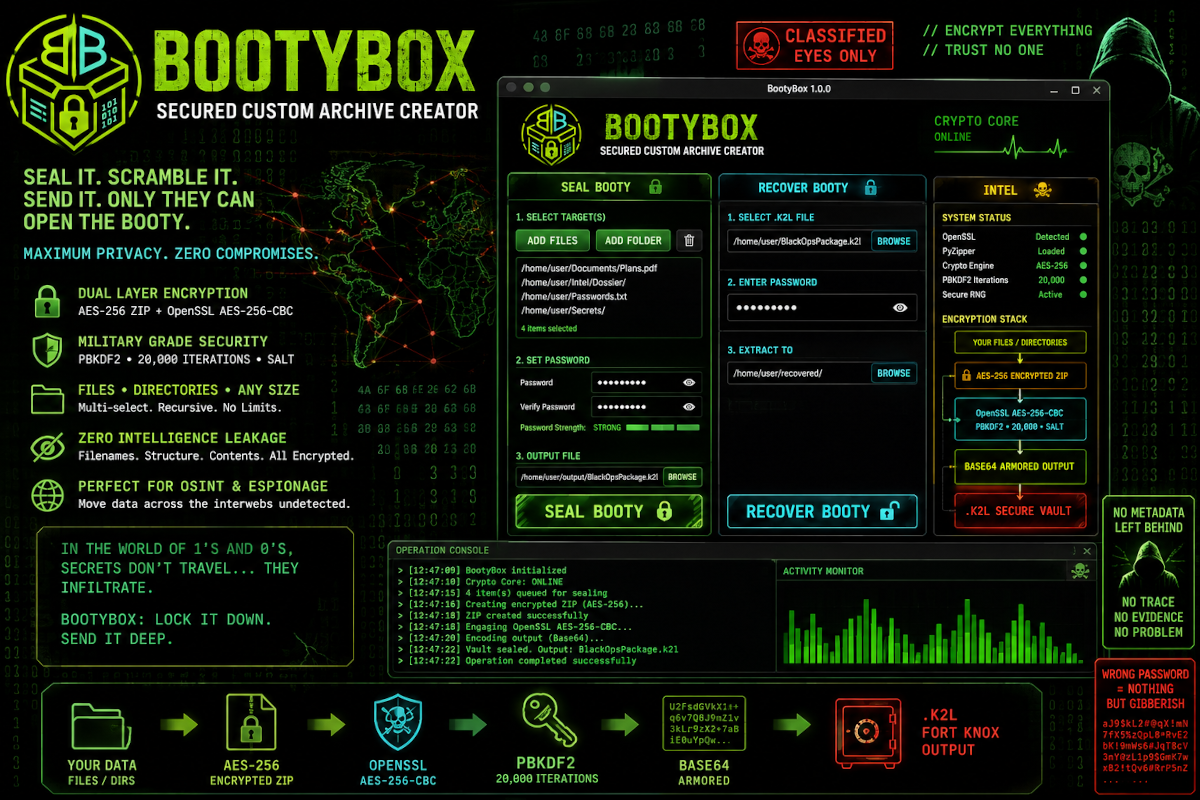
BootyBox should be evaluated as a password-derived encrypted archive system with a covert-style image carrier. Its security is a combination of cryptographic strength, password entropy, implementation quality, metadata exposure, and attacker resources.
AES-256 is a mature symmetric cipher. A realistic attacker is not expected to brute-force the 256-bit AES key space directly.
PBKDF2 deliberately makes password guesses more expensive, but BootyBox 1.0 currently uses 20,000 iterations, which is modest by modern password-hardening standards.
The carrier hides the encrypted payload behind a normal PNG file, but appended data can be discovered by an analyst who knows what to inspect.
With a high-entropy password, offline cracking becomes computationally prohibitive. With a predictable password, strong encryption cannot rescue poor human choices.
BootyBox deliberately separates the encryption process into multiple stages. Each stage has a different purpose: packaging, encryption, password hardening, transport encoding, and final carrier generation.
openssl aes-256-cbc -pbkdf2 -iter 20000 -salt -a -e \
-in Payload.zip -out Payload.k2l -pass stdincat assets/images/icon.png Payload.k2l > Output/BootyBox_Output.pngThe password is passed through standard input rather than being included directly in the process command line. This reduces accidental exposure through process listings.
The final BootyBox artifact is a valid PNG image followed by encrypted trailing bytes. Most normal image decoders render the PNG and stop processing at the PNG end marker, leaving the additional data untouched.
A BootyBox icon image. The appended encrypted data does not need to participate in normal image rendering.
A technically capable analyst can inspect the PNG structure, locate the end of the normal image data, and observe that extra bytes exist afterward.
Discovering the appended bytes is not equivalent to decrypting them. The attacker still faces the password-derived OpenSSL encryption layer.
BootyBox recovery reads the PNG structure until the IEND chunk, extracts the bytes that follow it into a temporary encrypted payload, applies the user-supplied password through the OpenSSL decryption stage, opens the AES-encrypted ZIP, and restores the original hierarchy.
Security claims are only meaningful when the attacker is defined. BootyBox is strongest when protecting data at rest or in transit from unauthorized users who obtain the carrier file but not the password.
Casual inspection, ordinary file browsing, unauthorized opening, direct ZIP inspection, trivial extraction, unsophisticated guessing, and password attacks when the password has substantial entropy.
Compromised endpoints, keyloggers, memory capture while data is decrypted, malware with access to plaintext files, shoulder surfing, password reuse, social engineering, or an attacker who already knows the password.
| Threat | BootyBox Effect | Assessment |
|---|---|---|
| Someone double-clicks the PNG | They see the carrier image, not the archived data. | Strong |
| Someone recognizes appended PNG data | The payload can be extracted, but remains encrypted. | Still protected |
| Dictionary password attack | Depends heavily on password predictability. | Password-dependent |
| High-speed offline password guessing | PBKDF2 increases cost per guess, but 20,000 iterations is not an aggressive work factor. | Moderate hardening |
| Direct AES-256 key brute force | The raw key space is astronomically large. | Not practical |
| Compromised machine during recovery | Plaintext may be exposed by the endpoint. | Outside crypto boundary |
Assuming an attacker knows exactly how BootyBox works, the rational path is not to attack the image or AES directly. It is to extract the encrypted payload and perform offline password guesses.
1. Obtain BootyBox PNG
2. Parse PNG structure
3. Locate IEND
4. Extract trailing encrypted bytes
5. Base64-decode the OpenSSL payload
6. Read salt / derive candidate key using PBKDF2
7. Attempt AES-256-CBC decryption
8. Test whether decrypted output resembles the expected ZIP
9. If invalid: guess another password
10. Repeat
This is an offline attack. BootyBox is not present to rate-limit the attacker. Once the encrypted file is obtained, the attacker can make as many guesses as their hardware and software allow.
A password is not strong because it looks complicated. It is strong when it is difficult for an attacker to predict. Length, randomness, uniqueness, and the method used to choose the password matter more than cosmetic complexity.
password123BootyBox2026!SecretFiles!
These follow patterns attackers expect and can prioritize.
rQ7!vZ2#Lx9@Pm4$
A genuinely random password drawn from a large character set has far more effective entropy than a themed phrase with substitutions.
A long multi-word passphrase can be excellent when its words are selected randomly rather than written as a natural sentence.
A nominal password space can be enormous while the effective human password space is much smaller. People reuse familiar words, names, years, keyboard patterns, capitalization rules, suffixes, substitutions such as 3 for E, and predictable punctuation. Modern cracking tools exploit those habits before attempting exhaustive brute force.
Password strength can be approximated using entropy, measured in bits. A search space with n bits of entropy contains approximately 2^n equally likely possibilities.
The division by two reflects the average case: if guesses are made through the entire search space, the correct value is expected roughly halfway through. Actual password attacks are often non-uniform and prioritize likely human choices, so weak human-generated passwords can fall much sooner than a pure entropy model suggests.
The table below deliberately uses hypothetical password-testing rates of 1,000, 10,000, and 100,000 guesses per second. These are not claims about a specific GPU or cracking tool. Real rates vary with hardware, software, PBKDF2 implementation, parallelism, password length, and system configuration.
| Effective Entropy | Search Space | 1,000 guesses/sec | 10,000 guesses/sec | 100,000 guesses/sec |
|---|---|---|---|---|
| 30 bits | ≈ 1.07 billion | ≈ 6.2 days average | ≈ 14.9 hours average | ≈ 1.5 hours average |
| 40 bits | ≈ 1.10 trillion | ≈ 17.4 years | ≈ 1.74 years | ≈ 63.6 days |
| 50 bits | ≈ 1.13 quadrillion | ≈ 17,839 years | ≈ 1,784 years | ≈ 178 years |
| 60 bits | ≈ 1.15 quintillion | ≈ 18.3 million years | ≈ 1.83 million years | ≈ 182,669 years |
| 80 bits | ≈ 1.21 × 10²⁴ | ≈ 19.2 trillion years | ≈ 1.92 trillion years | ≈ 191.5 billion years |
“Can this be cracked?” is incomplete without asking who is attacking, what resources they have, what they know about the owner, and how predictable the password is.
A person manually opening the image or guessing passwords is unlikely to make meaningful progress unless the password is obvious, reused, disclosed, written down nearby, or derived from information they already know.
A technically capable user can identify appended data, extract the payload, recognize the OpenSSL format, and attempt dictionaries or rule-based password lists. Weak passwords can fail quickly at this level.
A skilled attacker can automate carrier extraction, optimize candidate generation, use leaked password corpora, profile the target, parallelize guesses, and potentially use GPU or distributed resources. Strong high-entropy passwords remain the primary defense.
AI can improve candidate selection by generating likely passwords from context, names, dates, language patterns, themes, public information, and prior password habits. It does not create a cryptographic shortcut through AES-256.
Better models can rank human password guesses more intelligently, while large compute increases the number of guesses attempted. Against a genuinely random high-entropy secret, however, the attacker still encounters a combinatorial search problem.
AI changes password attacks primarily by improving prediction, prioritization, and automation. It does not make modern symmetric cryptography irrelevant.
Learning common password structures, generating targeted mutations, incorporating public context, ranking likely phrases, combining known personal themes, and automating analysis of carrier files.
Recovering a uniformly random 80-bit password without performing an enormous search, deriving an AES key from ciphertext alone, or bypassing the mathematical security properties of AES because it can reason about the file.
AES-256 provides a very large cryptographic key space. Direct exhaustive search of the AES key itself is not a realistic attack strategy.
The OpenSSL layer uses PBKDF2 and a salt, preventing identical passwords from trivially producing identical derived material across independently encrypted payloads.
The files exist inside an AES-encrypted ZIP before the entire ZIP is encrypted again by the outer OpenSSL layer.
The outer encryption layer covers the ZIP byte stream, keeping normal archive structure and filenames from being directly readable without decryption.
BootyBox does not maintain a central recovery key. This removes one convenient centralized secret store, although it also means forgotten passwords can mean permanent data loss.
The password is passed to OpenSSL using standard input instead of appearing plainly as a command-line password argument.
A credible security report must identify what the design does not provide. These limitations do not make BootyBox useless; they define where future versions can become stronger.
BootyBox 1.0 uses 20,000 PBKDF2 iterations. This slows guessing compared with a raw password-to-key transformation, but it is relatively light by current password-hardening standards. Increasing the work factor would raise the cost of every offline guess.
AES-CBC provides confidentiality, but CBC mode by itself is not an authenticated-encryption construction. Confidentiality and tamper authentication are separate security properties.
The carrier is useful concealment against casual inspection, not against forensic analysis. A knowledgeable analyst can identify bytes after the PNG end marker.
When BootyBox decrypts an archive, plaintext exists on the user's machine. Malware, keyloggers, compromised accounts, memory inspection, or insecure recovered-file storage can defeat otherwise strong encryption.
Best-effort overwriting cannot guarantee physical erasure on every SSD, journaling filesystem, copy-on-write filesystem, snapshot system, virtual disk, or cloud-synchronized environment.
BootyBox intentionally has no master key. There is no cryptographic back door to rescue a user who forgets a sufficiently strong password.
The strongest improvements for future BootyBox versions are not about adding more visual secrecy. They are about making password attacks more expensive and adding authenticated integrity.
| Improvement | Security Benefit | Compatibility Impact |
|---|---|---|
| Increase PBKDF2 iterations | Raises cost of every legitimate key derivation and every attacker guess. | Existing 1.0 containers require legacy settings during recovery. |
| Adopt a memory-hard KDF such as Argon2id | Makes highly parallel cracking more resource-intensive. | Would require a new container format/version and additional dependency support. |
| Add authenticated encryption or a strong MAC | Provides explicit tamper detection in addition to confidentiality. | Requires a versioned format change. |
| Store a BootyBox format marker inside encrypted content | Allows reliable internal validation after successful outer decryption without exposing plaintext metadata outside. | Minor format change. |
| Password entropy meter | Helps users distinguish long/random secrets from cosmetic complexity. | UI-only improvement. |
| Optional random password generator | Reduces the human predictability problem directly. | UI-only improvement. |
BootyBox 1.0 is not “uncrackable,” because responsible cryptography should not be described that way. It is a layered password-based encryption system whose real security can range from poor to extremely strong depending primarily on password entropy and endpoint security.
An attacker who extracts the payload can conduct an offline dictionary or rule-based attack. Human-themed passwords, reused passwords, names, dates, predictable suffixes, and common substitutions can dramatically reduce the effective search space.
The problem changes into a massive search. AES-256 itself is not realistically brute-forced, and sufficiently high password entropy can drive exhaustive password search into timescales that are operationally meaningless.
Never reuse a password from email, websites, accounts, or other archives. A breach elsewhere should not reveal a BootyBox secret.
Long randomly generated secrets or randomly selected passphrase words are much harder to predict than personally meaningful phrases.
Strong encryption cannot compensate for malware or an attacker already observing the machine while data is being decrypted.