
01
Generate
Create fictional SSIDs from several naming personalities including mixed, industrial, boring, cryptic, and fully randomized patterns.
This release is a base module and proof-of-concept application. It is not wired into an operational network stack, authentication service, captive portal, DHCP server, routing layer, monitoring backend, or external control system. It exists to demonstrate controlled beaconing, SSID rotation, hardware capability checks, and the user interface model.
Complete source package. All project files included.
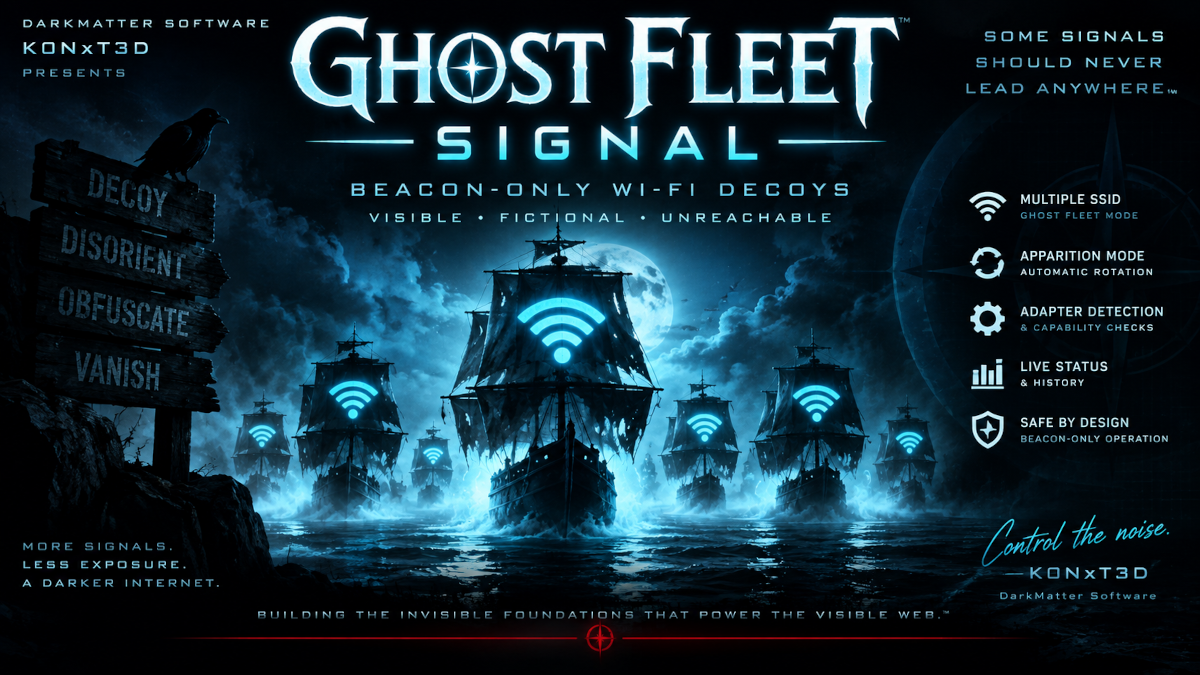
Ghost Fleet Signal creates fictional Wi-Fi identities that can appear on nearby client devices while deliberately refusing to become a functioning network. Apparition Mode can retire one identity and replace it with another over time.
Create fictional SSIDs from several naming personalities including mixed, industrial, boring, cryptic, and fully randomized patterns.
Use Linux hostapd and nl80211 to place a compatible dedicated Wi-Fi radio into AP mode and advertise the staged ghost identity.
Apparition Mode rotates the active identity on a configurable interval, preserving a local history of which SSIDs appeared and how long they remained active.
Multiple SSIDs at the same time require more than basic AP mode. The chipset, Linux driver, firmware, and reported valid interface combinations all have to permit multiple AP virtual interfaces.
iw list proves the actual adapter/driver/firmware combination supports the required number of AP interfaces.
| Hardware / Class | Chipset / Driver | Form | Why it is interesting | Ghost Fleet Status |
|---|---|---|---|---|
| Compex WLE900VX | Qualcomm QCA9880 / ath10k | Mini PCIe, 3×3, 3 × U.FL | Strongest research target. Linux Wireless explicitly documents ath10k multiple-BSSID operation with several virtual APs, and Compex documents the WLE900VX as QCA9880 with Linux/OpenWrt ath10k use. | Priority Candidate |
| Compex WLE600VX | Qualcomm QCA9882 / ath10k | Mini PCIe, 2×2, 2 × U.FL | Same ath10k family with a 2×2 radio. Manufacturer documentation specifically identifies QCA9882 and ath10k/OpenWrt support. | Priority Candidate |
| QCA9880 / QCA9882 ath10k modules | Qualcomm Atheros / ath10k | Typically Mini PCIe | The driver family itself has documented mBSSID support. Exact card, firmware, regulatory domain, and platform still matter. | Driver-Level Candidate |
| AR9380 / AR9382 / AR9580 class cards | Qualcomm Atheros / ath9k | PCIe / Mini PCIe | ath9k has mature in-kernel AP support across these chip families and is historically friendly to mac80211 virtual-interface workflows. Exact simultaneous-AP limits must still be read from the installed radio. | Strong Candidate |
| AIRETOS AEX-AR9580-NX / AR959x family | AR9580 / AR9590 / AR9592, ath9k | Full Mini PCIe | Linux Wireless lists these as external ath9k products. They are useful examples of discrete Atheros radios where the kernel driver, rather than a vendor USB stack, controls AP behavior. | Legacy Candidate |
| ALFA AWUS036ACM | MediaTek MT7612U / mt76 | USB, dual-band | Very good modern Linux compatibility and mainline kernel support. However, the sources reviewed here do not establish a guaranteed multi-BSS count for this exact USB adapter. | Investigate First |
| ALFA AWUS036NHA | Atheros AR9271 / ath9k_htc | USB, 2.4 GHz | Excellent Linux support, but Linux Wireless specifically describes AP/P2P as experimental for ath9k_htc and says using one AP VIF is a good idea because multiple-interface support has not been extensively tested. | Not a Multi-AP Pick |
Antennas do not create multi-AP capability. That comes from the radio, firmware, and driver. For a discrete Mini PCIe module, match the antenna system to the number of RF chains:
iw list

Look under:
valid interface combinations:

A useful multi-AP radio may report something conceptually similar to:
#{ AP } <= 4

A one-ghost radio may instead report:
#{ AP } <= 1
Ghost Fleet Signal performs its own capability check before launch. If the installed adapter reports only one simultaneous AP interface, the application can still operate as a single rotating apparition, but it cannot create several concurrent SSIDs on that radio.
The proof-of-concept is intentionally narrow. The application stages identities, hands a dedicated radio to hostapd, verifies AP state, and rotates the identity when Apparition Mode is enabled.
Ghost Fleet refuses to take over a Wi-Fi interface that is already being used as a client connection. A dedicated radio is the intended configuration.
Privileged radio setup is handled through a controlled helper session so normal operation does not become a cascade of repeated authorization prompts.
Closing the main window hides it while the application continues running. The tray menu is the deliberate path for returning to the interface or exiting the process.
The present proof-of-concept is centered on 2.4 GHz hostapd operation using channels 1–11. Hardware capable only of 5 GHz operation is not a suitable target for this build without additional application changes.
The application can stage up to several ghost identities, but the effective simultaneous fleet size is ultimately capped by what the selected Linux radio reports as a valid AP interface combination.
Ghost Fleet Signal is built around a simple line: advertise a fictional access point identity, then stop. The proof-of-concept intentionally avoids the mechanisms that would turn a decoy beacon into credential collection or active interference.
Wireless spectrum, transmit power, channels, antenna systems, and access-point operation are subject to local regulations and site policy. The software does not grant authority to transmit, interfere with other networks, impersonate third parties, or bypass applicable rules.
The hardware table above is not a compatibility certification. It is a starting point assembled from Linux Wireless driver documentation and manufacturer chipset documentation. Ghost Fleet testing still has the final word.